Hiring Pulse Q1
Tech job openings were up in Q1, with Software Engineering losing share

Everyone on earth has an interest in how AI impacts the job market. Smart people disagree about whether today's AI can replace human labor, but one thing that's obvious is that we need better data. So I did what any high-agency tech bro would do: I started collecting some.
I call it Hiring Pulse. The system tracks and analyzes job listings from over one thousand curated companies, mostly VC-backed startups and public tech.1 These are early adopters of technology who respond to changes quickly, so they would likely show shifts before the broader market. It's the same profile as my consulting client base. The fun companies.
Key Findings
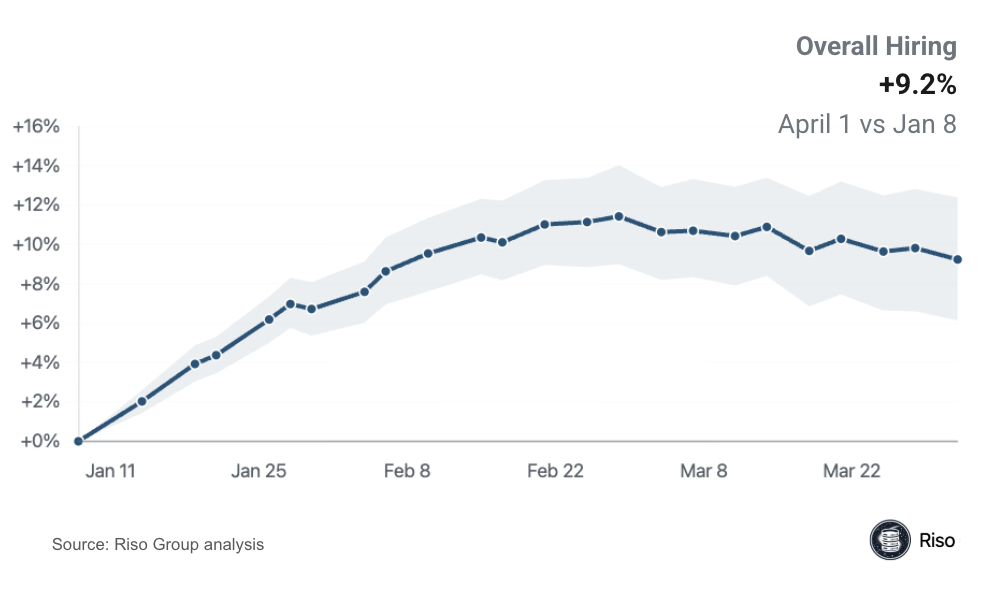
- Open roles are up ~9% over the course of Q1. There is no hiring collapse (yet?)
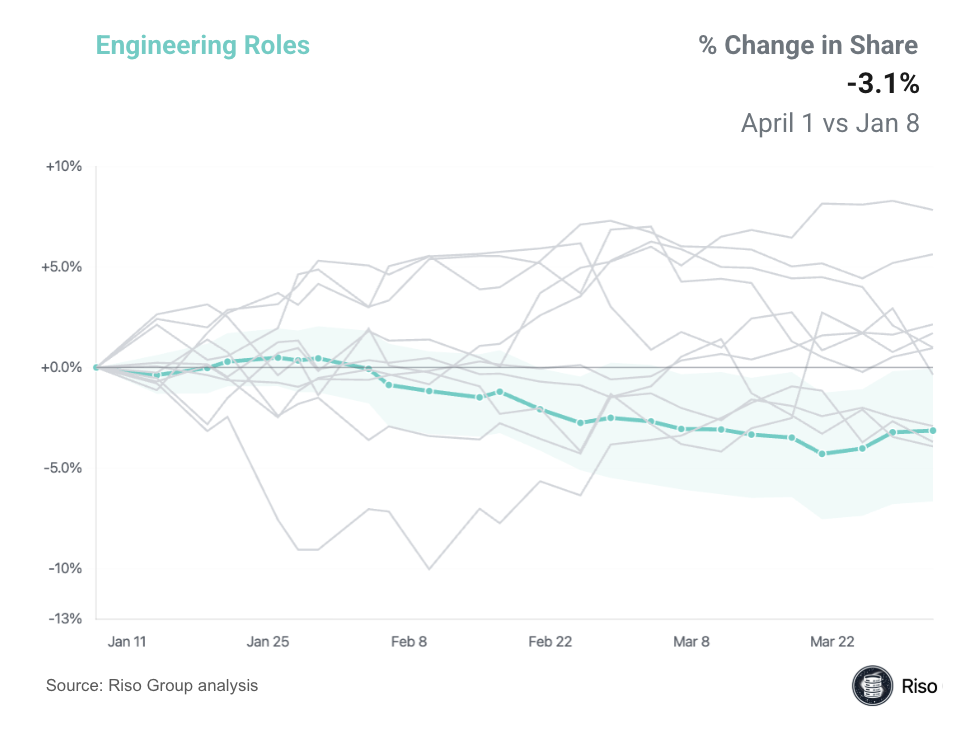
- “Software Engineering” roles are losing share. The only category to decline at a statistically significant rate
- “AI Engineering” is trending up but at this point not statistically significant
- Most other categories unchanged. G&A is the one exception (gaining share significantly), but others, most notably Customer Support, show no movement
Job openings are up, not down
Open roles grew ~9% from the January 8 baseline through Q1, to 28,324 tracked positions.2
Software Engineering is slipping
Of 11 role categories, only two showed statistically significant share changes:
- Engineering share fell 3.1%, from ~18.8% to 18.2% of all roles (-0.6 percentage points)
- G&A share rose 5.6%, from ~7.3% to 7.7% of all roles (+0.4 percentage points)
The “AI Engineering” category is the one to watch. Its share is trending up (+7.8%) but hasn't crossed the significance threshold yet.
How are these categories defined?
Roles are classified by text analysis of job titles. “Engineering” covers traditional software engineering roles: Software Engineers, Backend/Frontend Engineers, DevOps, SREs. “AI” covers roles whose primary function is building AI systems: ML Engineers, AI Engineers, Research Scientists.3
Go deeper
The live dashboard is updated regularly with data on all 11 categories.
We have the full text of every job posting, which will support deeper analysis of job descriptions, seniority, and compensation.
If you're doing research in this space or interested in the underlying data, get in touch.
Notes
- 1. Job postings are scraped twice a week and classified into consistent role categories. Changes between any two dates are measured using a paired intersection bootstrap: we find companies present in both scrapes, resample with replacement, and compute 80% confidence intervals around the change. If a shift doesn't clear the threshold, we don't call it significant. Full methodology on the dashboard page. ↩
- 2. Measuring change across 1,100+ companies with varying scrape coverage is tricky. The paired bootstrap handles this by resampling the company set 1,000 times and recomputing the change each time. The 80% confidence interval for overall growth sits entirely above zero. ↩
- 3. Roles like "Program Manager, AI Engineering" are excluded because the primary function is management, not AI development. ML Engineer was deliberately placed in AI rather than Data to reflect the skillset split. ↩